

Last Updated: November 15, 2026
Quick Summary
Most inboard engine overheat problems start on the raw-water side, where a clogged strainer, a worn impeller or a blocked intake cuts the flow of lake or sea water used for cooling. Overheating that appears only at higher RPM often points to a capacity problem, such as a fouled heat exchanger, a late-opening thermostat or a collapsed hose.
- Check that water discharges from the exhaust at idle; a weak or missing stream points to the raw-water path.
- Note whether the engine overheats at idle, at cruise or steadily, since the pattern narrows the cause.
- Inspect and clear the raw-water strainer and intake, then retest under load.
- Reduce throttle immediately if the gauge climbs, and never open a hot pressurized cap.
- Flush the raw-water system after saltwater use and at the end of each season.
Table of Contents
- Boat Engine Overheating Causes: Start With Raw-Water Flow
- Inboard Engine Overheating at Higher RPM: What Changes Under Load
- Boat Engine Overheating: What to Do Right Now
- Preventing the Next Overheat: Flushing Your Raw-Water System
- Frequently Asked Questions
Boat Engine Overheating Causes: Start With Raw-Water Flow
Most inboard engine overheating starts with the raw-water side: the lake or ocean water your engine pulls in to cool itself. When that flow drops, the engine runs hot fast. This is usually the cheapest problem to check.
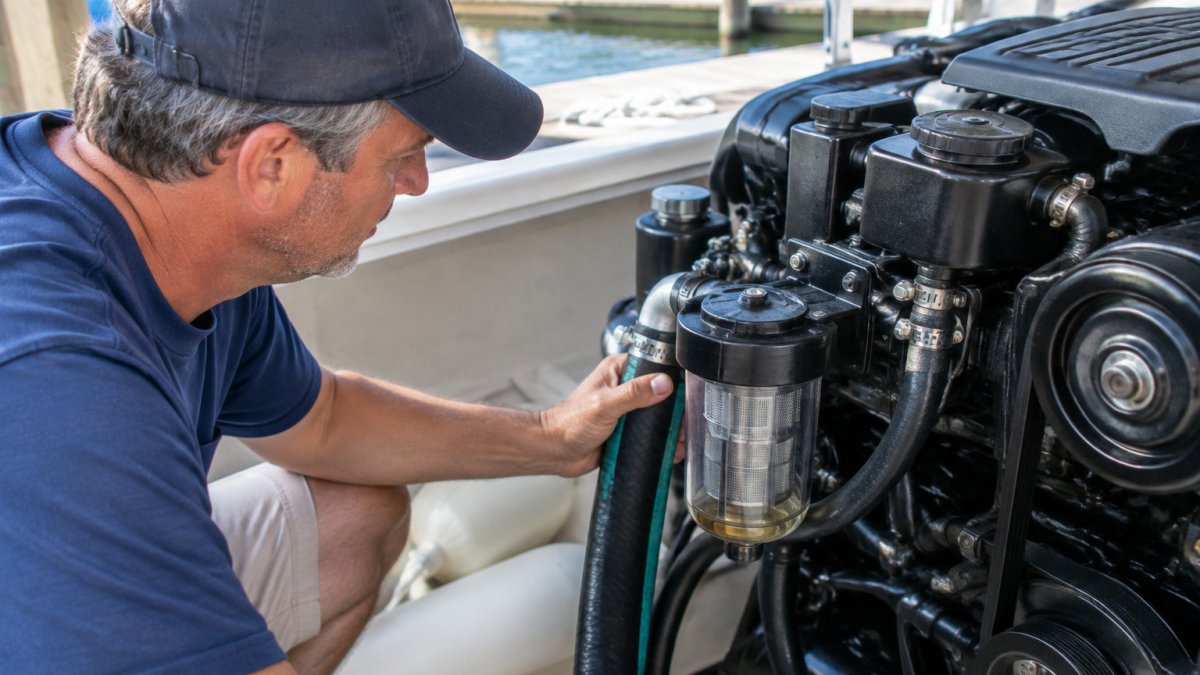
Common culprits include a clogged raw-water strainer, a worn impeller in the raw-water pump, and a blocked intake. Salt, silt, and grime build up over time and choke the flow. For a closer look at how salt buildup and corrosion restrict raw-water flow, see Preventing Salt Corrosion in Marine Engines.
A simple check: with the engine running at idle, confirm water is exiting the exhaust. A weak or missing stream points straight back to the raw-water path.
!A dockside workshop photo of an inboard engine raw-water strainer and intake hose
Inboard Engine Overheating at Higher RPM: What Changes Under Load
Overheating that only shows up at higher RPM is a different diagnostic problem from overheating at idle. At cruise and wide-open throttle, the engine rejects far more heat, so the cooling system needs full raw-water flow, an unrestricted heat exchanger, and a thermostat that opens fully.
Start by reading the pattern, not just the number:
- Overheats at idle, cools at speed. Usually a low-flow raw-water supply problem, a partially clogged strainer, a tired impeller, a restricted intake, or air pulled into the raw-water pump. Once RPM rises, the pump can sometimes overcome the restriction.
- Normal at idle, climbs at cruise or wide-open throttle. Points to a capacity problem: a heat exchanger fouled on the raw-water side, a thermostat that opens late or only partway, a collapsed hose that restricts under suction, or an exhaust elbow/riser restriction.
- Climbs steadily regardless of RPM. Suggests a global flow loss, low coolant on a closed-cooling engine, a failing circulation pump, a slipping raw-water pump belt, or a major blockage.
- Spikes quickly under load, then drops when you pull back. Often flow starvation that only appears when demand is high; check the raw-water intake for a partially blocked grate or a strainer full of eelgrass, sand, or scale.
Know which cooling system you have before you chase the wrong part. A raw-water-cooled inboard sends lake or sea water straight through the block and manifolds, so a restriction anywhere in that path shows up fast. A freshwater-cooled (closed-cooling) inboard uses a heat exchanger: engine coolant circulates in a sealed loop, and raw water cools it through the exchanger. There, overheating under load is often a raw-water-side problem at the exchanger or a coolant-side problem in the closed loop, two different checks.
Concrete checks that separate the causes:
- Watch the gauge under load, not at the dock. Note the RPM and load where the temperature climbs, and whether it recovers when you throttle back. That pattern is the single most useful clue.
- Confirm raw-water discharge at speed. A stream that weakens or disappears as RPM rises points to a supply restriction or a failing impeller.
- Inspect the raw-water strainer and intake. Clear debris, then re-test under load; a strainer half full at idle may be fully blocked once the pump pulls harder.
- Check the impeller and pump belt. A worn impeller can move enough water at idle but not at cruise; a glazed or loose belt can slip under load.
- Feel the hoses and look for collapse. A hose that softens, kinks, or collapses under suction restricts flow exactly when demand is highest.
- Test the thermostat and inspect the heat exchanger. On a closed-cooling engine, a late-opening thermostat and a raw-water side fouled with scale both show up as load-only overheating.
Watch out: do not assume a high-RPM overheat is 'just the impeller' and keep running at cruise to 'see if it clears.' Sustained overheating under load can warp a head, damage exhaust components, and turn a cheap fix into a major repair. If you're wondering whether a garden hose can serve as a quick flush source at the dock, see Can You Flush a Boat Engine With a Garden Hose?.
Boat Engine Overheating: What to Do Right Now
An overheat on the water is a damage-control situation first and a diagnostic situation second. The order you do things in matters more than any single check.
Step 1, Reduce load immediately. Ease the throttle back to idle and, if safe, shift to neutral.
Step 2, Protect yourself before you touch anything. A hot closed-cooling system is pressurized, and the coolant can be well above the boiling point of water.
Step 3, Triage afloat versus ashore. Some checks are safe on the water; others need a haul-out or a mechanic.
- Afloat: clear debris from the raw-water strainer; check the raw-water intake for a visible blockage; confirm water is discharging at the exhaust; check raw-water pump belt tension and condition; look for hose kinks, leaks, or collapse; check coolant level only after the engine is cool.
- Ashore or with a mechanic: pressure-testing the cooling system, pulling the heat exchanger for cleaning, replacing a hard-to-reach impeller, testing the thermostat, and inspecting the exhaust elbow/riser for restriction.
Step 4, Do measurable checks, not guesses. After the engine cools, note the temperature at idle and compare it with the manufacturer's normal range. A steady, strong raw-water discharge is the baseline; a weak or intermittent one points to the raw-water path.
Step 5, Decide whether to continue. If you cleared a strainer or debris and the temperature returns to normal at idle and under a short load test, proceed cautiously while watching the gauge.
Watch out: the most common self-inflicted damage in an overheat is opening a hot pressurized cap or restarting and running hard 'to flush it out.' Both can turn a clogged strainer into a cracked head or a scalded hand.
Preventing the Next Overheat: Flushing Your Raw-Water System
Regular flushing keeps salt and silt from building up in the raw-water path. If you want to avoid permanent installation, Flushing a Boat Engine Without Permanent Installation walks through the options. The No Fuss Flush™ from E-Z LAKE connects to your garden hose and sends fresh water straight to the raw-water inlet, so you don't have to crawl under the boat. You can see how it attaches and controls flow on the No-Fuss Way to Flush Your Inboard Marine Engine product page. It is designed for straight-drive inboard engines, where the raw-water pump is easily accessible. Its integrated on/off valve controls the flow, and it attaches and removes without permanent installation.
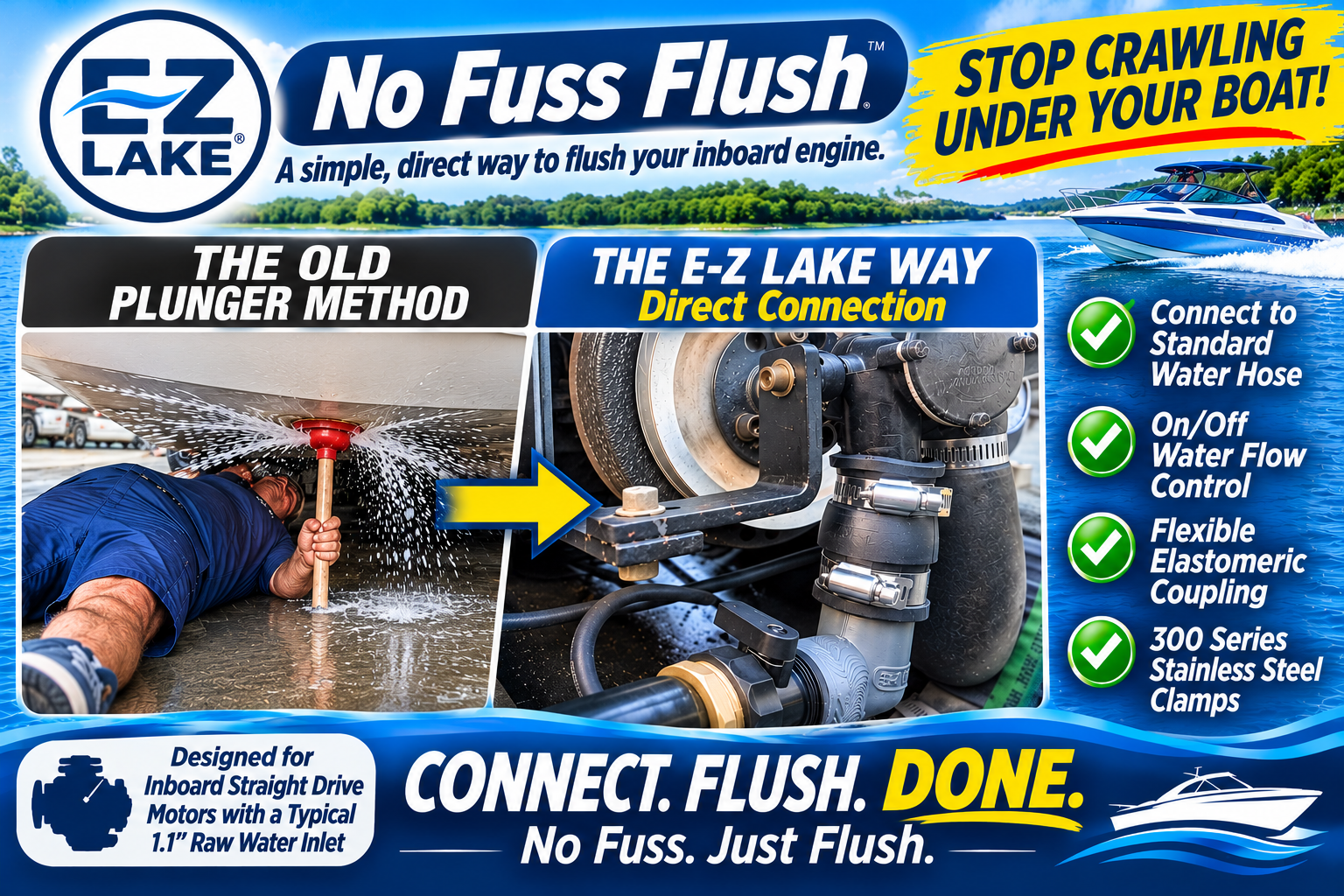
Flush after saltwater use and at the end of the season.
Best for: Boat owners with inboard engines who want a quick, non-permanent way to flush after every outing.
Skip if: Your engine has no accessible raw-water inlet for the fitting, since the No Fuss Flush connects at that inlet.
Flushing intervals and the product's key features are summarised below.
Item |
Value |
Note |
|---|---|---|
Flush timing |
After saltwater use |
Also at end of season |
Product |
No Fuss Flush |
Connects to garden hose |
Designed for |
Straight-drive inboards |
Raw-water pump easily accessible |
Flow control |
Integrated on/off valve |
Attaches and removes without permanent installation |
Check your raw-water flow first, flush regularly, and the overheating problem usually stays away. Get the No Fuss Flush™ at E-Z LAKE and make flushing a two-minute job.
Frequently Asked Questions
What are the common causes of a boat engine overheating?
The most common causes are restricted raw-water flow from a clogged intake or strainer, a worn or damaged water-pump impeller, a stuck or failed thermostat, low coolant in closed-loop systems, a fouled heat exchanger, and collapsed or restricted cooling hoses. Start with the raw-water side because it is the easiest to check. Confirm water is discharging from the exhaust outlet at a steady stream, then inspect the strainer and intake before moving to the impeller and thermostat.
Is an engine ruined if it overheats?
Not always, but continued overheating can cause serious damage, including warped cylinder heads, cracked components and failed gaskets. Shut the engine down as soon as the temperature alarm sounds or the gauge climbs past normal. Let it cool before inspecting, and only restart once you have found and corrected the cause. If the engine overheated badly or ran hot for a long time, have a marine mechanic check it before returning it to service.
