

Last Updated: November 11, 2026
Quick Summary
Yes, you can flush a boat engine with a garden hose by connecting it to the raw-water pump inlet with a rubber coupler. Remove the current hose and fit the coupler over the inlet, attach your garden hose, then run fresh water through before shutting it off and removing the coupler.
- The raw-water pump inlet hose is typically about 1.1 inches across.
- Flexible couplers usually stretch to about 1.375 inches to fit the inlet.
- A 5/8-inch hose is the most common size, though 1/2- and 3/4-inch hoses also appear.
- The unit is not designed to be pressurized, start engine and quickly turn on water supply. This is equivalent to the amount of time it would take to suck water from the bottom of the boat. Don’t over-rev or over-heat the engine.
Table of Contents
- How to Hook Up a Water Hose to an Inboard Boat Motor
- How Long Should You Flush a Boat Engine?
- Outboard Flush Kit Options: Muffs, Ports, and Couplers
How to Hook Up a Water Hose to an Inboard Boat Motor
Yes, you can flush a boat engine with a garden hose, and for inboards the hookup is simpler than most owners expect. E-Z LAKE's No Fuss Flush is built around that fact: your existing hose, your engine's raw-water inlet, no permanent plumbing. Connect to the raw-water pump inlet, not the inlet below the boat.
Here is the sequence we recommend for an inboard engine:
- Find the raw-water pump inlet hose. It is typically about 1.1 inches across.
- Remove existing hose and place the side where it will not interfere with engine operation.
- Attach your garden hose to the coupler. A 5/8-inch hose is the most common size, though 1/2- and 3/4-inch hoses also appear on docks, according to Easy Flow Designs' guide to flushing a boat engine. Test water flow and then close valve.
- Fit the rubber coupler over that inlet and tighten it. Flexible couplers usually stretch to about 1.375 inches.
- Start engine and immediately begin water flow.
- Open the valve, run fresh water through, then shut it off and remove the coupler.
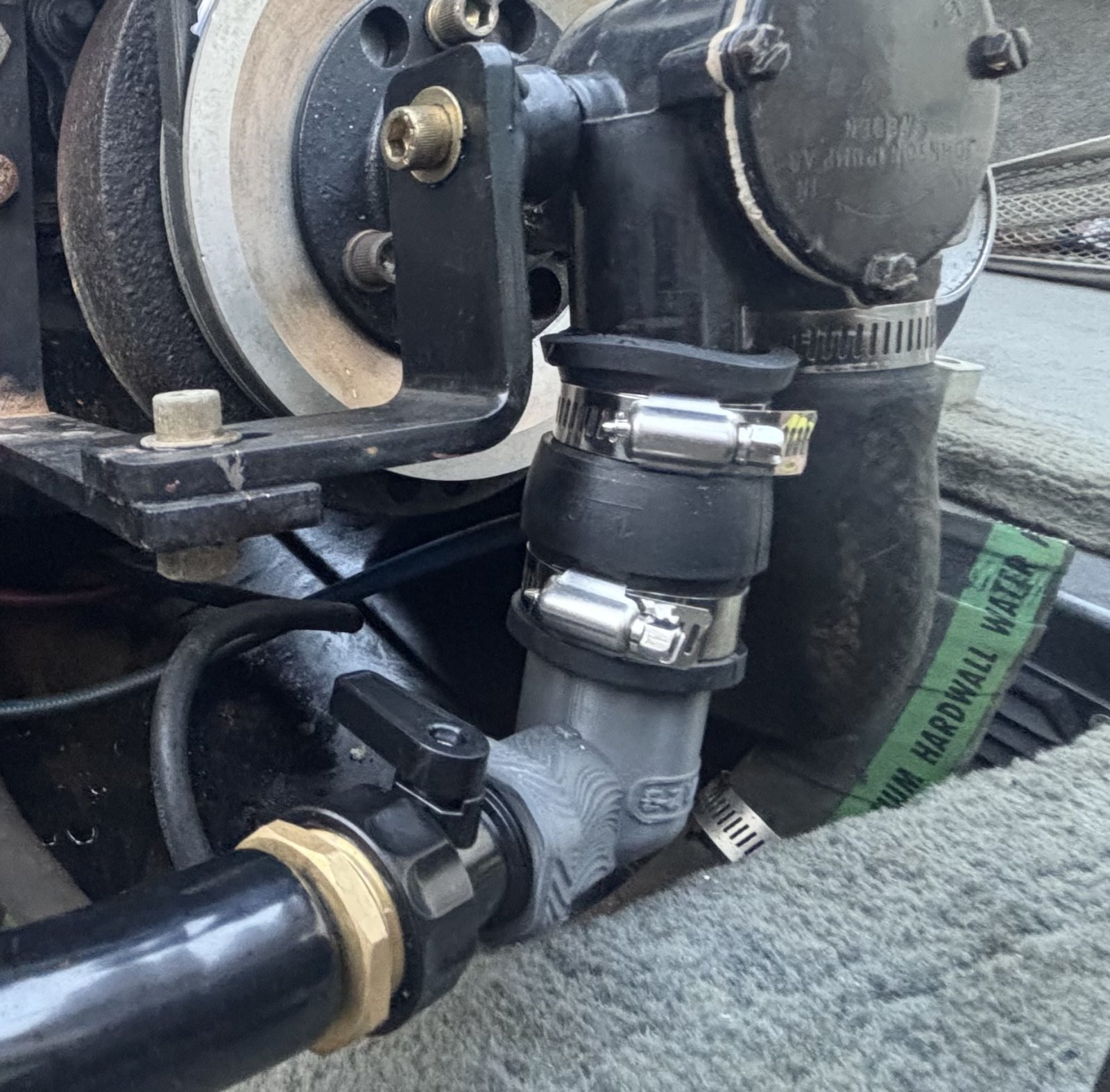
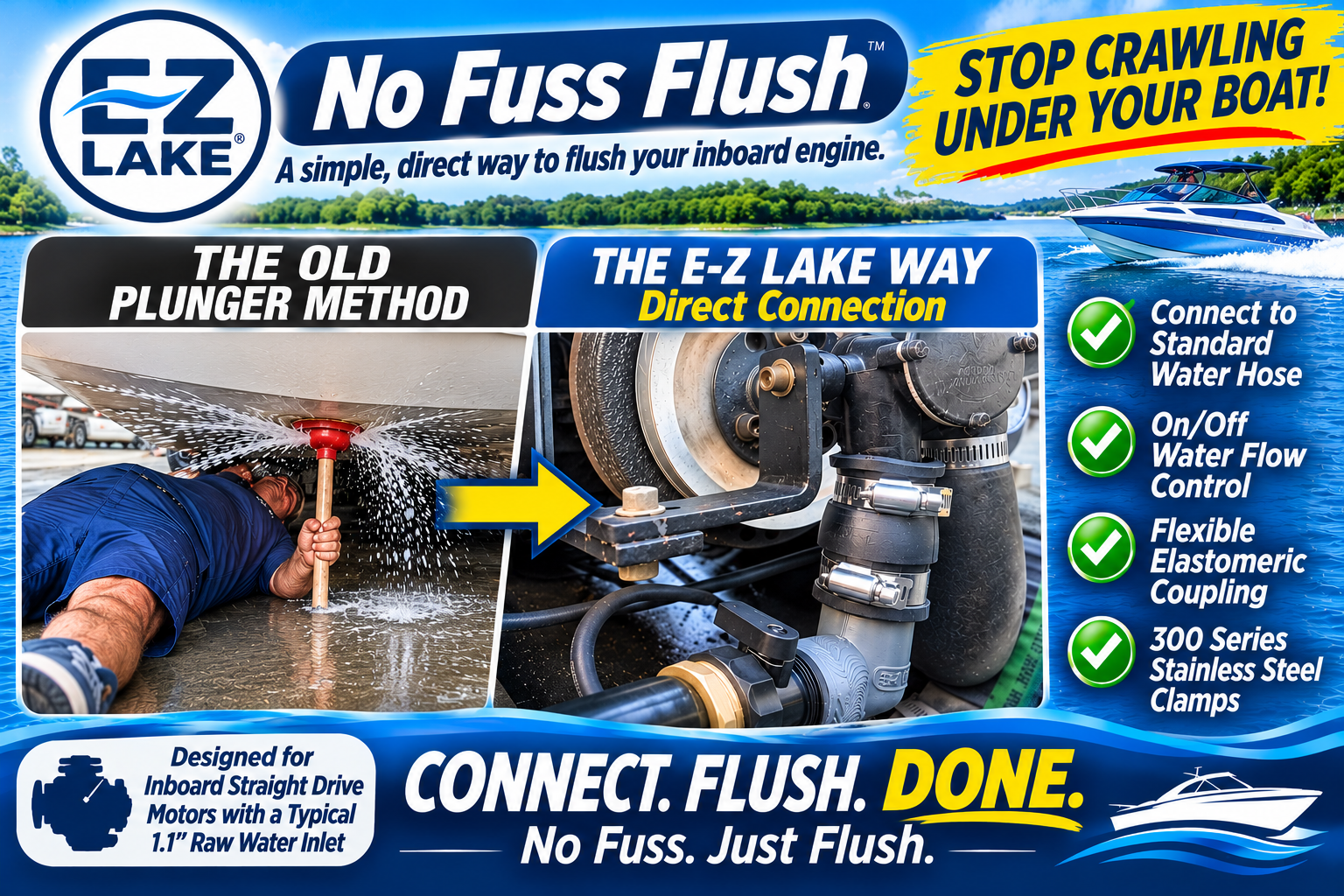
The No Fuss Flush does this with an integrated on/off valve to control water flow. When you are finished, disconnect it and store it away.
How Long Should You Flush a Boat Engine?
Your owner's manual is the final word on how long to flush your engine.
- Saltwater use demands a flush after every trip.
- Lake and river boats still benefit, since silt and sand collect in the cooling system.
- Watch the cooling-water indicator; weak flow means stop and troubleshoot.
Outboard Flush Kit Options: Muffs, Ports, and Couplers
Several hookup methods exist, and picking the right one comes down to what your engine already has:
Method |
Best For |
How It Connects |
Engine Running? |
|---|---|---|---|
Earmuffs |
Outboards with no flush port |
Muffs clamp over lower-unit intakes |
Usually yes, per manual |
Built-in flush port |
Most modern outboards |
Hose fitting on the cowling |
Often no, per manual |
Inlet coupler |
Inboards and sterndrives |
Coupler over raw-water pump inlet |
Follow manual |
Earmuffs clamp over the lower-unit water intakes, attach to the hose, and turn on the water. Water must flow before the engine turns over.
Built-in flushing devices are simpler where they exist, and model-specific instructions from your owner's manual should always be followed.
Inlet couplers suit inboards and sterndrives, where there is no lower-unit intake to clamp onto. The No Fuss Flush connects to the raw-water pump inlet for this purpose.
For more on marine maintenance, read our piece on innovation in marine maintenance.
Troubleshooting weak or absent water flow
No water at the indicator usually means a kinked hose, a half-open valve, muffs not seated over the intakes, or low house water pressure. Check the simplest cause first.
Flushing when no tap is available
Boat owners on a mooring or a remote ramp can still flush with a portable fresh water tank and pump plus a short hose, or a freshwater washdown system plumbed to a tank. Plan for the same 5 to 10 minutes of flow.
E-Z LAKE's No Fuss Flush connects to your raw-water inlet with a flexible rubber coupler and an integrated on/off valve to control flow, with no permanent installation. It is designed in the USA by boaters and is patent pending. Get started with E-Z LAKE and spend your dock time on the water instead of under the hatch.
